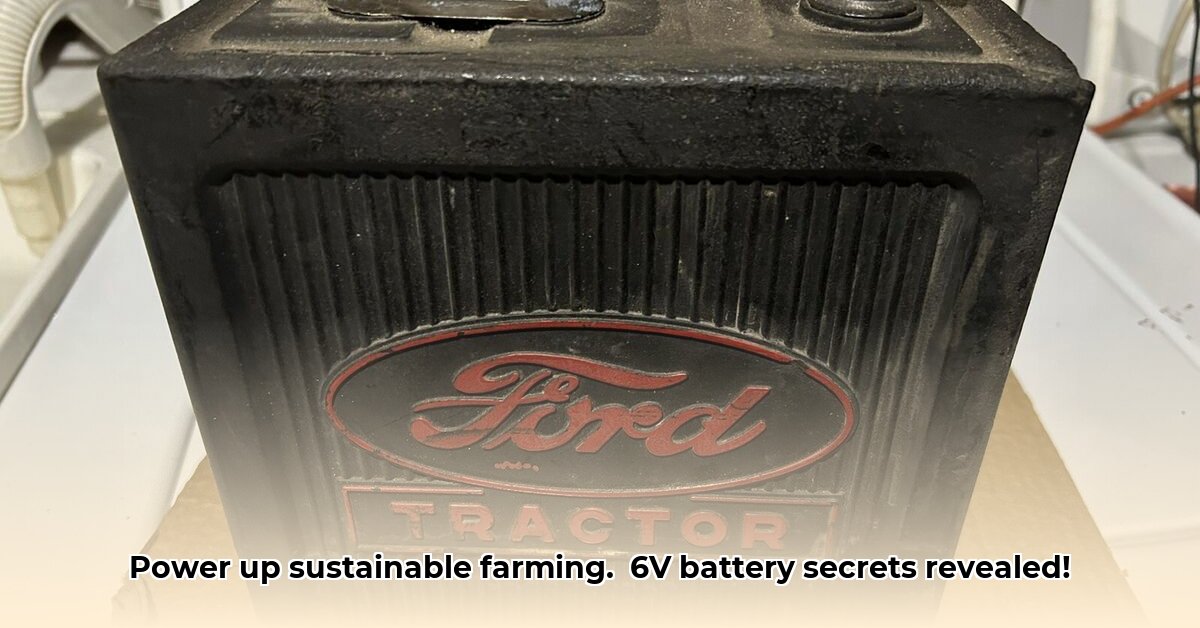
Understanding Your 6-Volt Battery Choices
Reliable power is the backbone of efficient and sustainable farming. This guide focuses on maximizing the lifespan and utility of Tractor Supply's 6-volt batteries within your agricultural operations. Choosing the right battery can significantly impact your farm's productivity and environmental footprint. Don't underestimate the importance of selecting the correct battery for the job! A faulty or improperly chosen battery can lead to significant downtime and wasted resources.
For more information on compatible chargers, check out our battery charger selection guide.
We'll cover selecting the appropriate battery, installation, maintenance, and troubleshooting, ultimately ensuring your operations run smoothly and efficiently.
Deep-Cycle vs. Starting Batteries: Key Differences
Tractor Supply offers two primary types of 6-volt batteries: deep-cycle and starting. Understanding their differences is vital for selecting the correct battery for your specific needs.
Deep-cycle batteries: Designed for slow, sustained discharges over extended periods, these are perfect for applications like electric fencing, solar-powered water pumps, and low-power lighting. They're built to withstand repeated cycles of charging and discharging. Think of them as the workhorses of your sustainable farm.
Starting batteries: Designed for delivering high bursts of power for short durations, like starting a vehicle engine, these are generally not suitable for prolonged or continuous use. They are not known for their longevity in applications requiring repeated discharges.
Choosing between the two hinges entirely on your application. A deep-cycle battery is ideal for continuous power demands, while a starting battery is best suited for quick bursts of power.
Selecting the Right Battery for Your Sustainable Farm
The amp-hour (Ah) rating is the most crucial specification when choosing a 6-volt battery. The Ah rating indicates the battery's capacity to deliver power over time. Higher Ah means more power and longer run-time between charges. But how do you determine the right Ah for your needs? Let's examine common agricultural applications:
Electric Fencing: Powering Your Perimeter
Electric fencing is a cornerstone of sustainable livestock management. The required Ah rating depends on factors like fence length, number of wires, terrain, and the desired duration between charges. A longer, more challenging fence necessitates a higher Ah battery. How long do you want your fence energized between charges? This directly impacts the Ah rating required.
Water Pumps: The Lifeblood of Irrigation
Efficient irrigation is paramount, particularly in arid regions. Solar-powered water pumps rely heavily on your battery's capacity. The pump's type (submersible or surface) and the required water flow rate directly influence the necessary Ah rating. Submersible pumps generally consume more power than surface pumps. A high-flow rate demands a battery with a proportionately higher Ah rating. What is the power draw of your pump? This is a critical aspect of battery selection.
Other Applications: Expanding Your Power Options
Beyond fencing and pumps, 6-volt batteries power various other farm implements: gate openers, low-voltage lighting, certain tools, and more. Always check the power requirements of these equipment before selecting your battery.
Installing Your Tractor Supply 6-Volt Battery: A Step-by-Step Guide
Safety Precautions: Always wear safety glasses and gloves when handling batteries. Work in a well-ventilated area, away from flammable materials. Consult the manufacturer's instructions for your specific battery and equipment.
- Preparation: Gather necessary tools (wire connectors, wrench), review your battery and equipment manuals.
- Placement: Select a secure, level location, shielded from extreme temperatures and moisture.
- Connections: Connect the positive (+) and negative (-) terminals correctly, ensuring secure and corrosion-free connections.
- Testing: Thoroughly inspect all connections and run a test before leaving the system unattended.
Maintaining Your 6-Volt Battery for Optimal Lifespan
Prolonging your battery's lifespan is key to both cost-effectiveness and environmental responsibility. Regular maintenance is crucial.
Proper Charging: Use a compatible charger and avoid both overcharging and deep discharging. Overcharging generates heat and shortens battery life, while deep discharging reduces its capacity over time.
Storage: Store unused batteries in a cool, dry place. Clean terminals to prevent corrosion and ensure optimum shelf life.
Regular Inspection: Periodically inspect terminals for corrosion. Clean them with a wire brush and baking soda solution. Tighten connections as needed.
Troubleshooting Common Battery Problems
Addressing problems early can save money and prevent downtime.
- Slow Discharge: Check for corrosion or loose connections.
- No Power: Examine fuses, switches, and connections.
- Battery Swelling: This indicates an internal issue; replace the battery immediately.
Recycling: A Sustainable Conclusion
Proper battery disposal is a crucial step in sustainable agriculture. Contact your local recycling center or Tractor Supply for responsible recycling options. Lead-acid batteries contain hazardous materials that should not be disposed of in landfills.
Choosing and maintaining the right 6-volt battery is an investment in efficient, sustainable farming. Remember, a well-maintained battery extends its life, saves money, minimizes environmental impact, and guarantees the reliable operation of your essential farm equipment.